Content Index
- Why choose the Book format for your training?
- From Beginner to Senior: The Truth About Learning Laravel 13
- Why is Laravel 13 the Engine of Successful Startups?
- Decision Table: What to learn first in Laravel 13?
- The "Pro Approach": How a Senior Writes Code in Laravel
- The Bridge to Your Next Level: Book and Definitive Book
- Your guaranteed learning path:
- Free Resources to Dive Deeper
- Read and Watch the First Chapters Totally Free
- Base Repositories and Complete Free Apps
- Try the Demo Application
- Why learn Laravel 13 today? (and what makes it so powerful)
- Productivity and modern ecosystem
- What changes in Laravel 13 compared to previous versions
- Laravel 13 to get a job and create real projects
- Syllabus of the book
- Content of the Book
- Summary
- MongoDB
- Integrating Laravel 13 with Vue 3
- Unique advantages of this book (that you won't find in others)
- Why learn Laravel
- Author's Real-World Experience
- Frequently Asked Questions
- Algunas recomendaciones
This is the MOST complete book you will find on Laravel, we will cover everything from basic aspects such as routes, controllers, views, models, form handling, and validations, among others, to more comprehensive aspects such as a REST API with an authentication token (and an app to consume it from Vue), cache management, roles, Gates for permissions, essential packages, and much more.
"If you have ever felt that the Laravel learning curve is an endless wall, let me tell you something: you are in the right place."
You can see the details of the book at the bottom of this publication, and the best part is that it is an investment for several years since, free of charge, I will maintain the book for several years for new versions and provide greater support through the Academy.
Free Update to Laravel 14
What you will learn in this Master book
- Why Laravel 13 is the most in-demand framework and how to master it without frustration.
- Full-Stack Pro: The exact path to go from beginner to Full-Stack Developer (Laravel + Vue 3 + Tailwind 4).
- Common mistakes when learning Laravel and how to avoid them with clean code (Pro Approach).
- Laravel 13 Core: Master routes, controllers, and models from the technical foundation.
- The exact path (Laravel + Vue 3 + Tailwind 4).
- Real Ecosystem: How to structure real-world applications: APIs, Roles (Spatie), Cache and SPA, Laravel AI SDK.
Why choose the Book format for your training?
While our video courses are ideal for following step-by-step, the book version of [Technology - e.g., Laravel 13] is designed for those developers looking for a quick technical reference resource and a more reflective learning experience.
- Ideal for instant queries: Thanks to its structured index and internal search engine, you can locate that design pattern or code configuration in seconds, without having to navigate through minutes of video.
- Deep reading without distractions: Perfect for studying at your own pace, underlining key concepts, and diving deeper into software architecture during those moments of disconnection.
- Total portability (PDF, ePub, and Kindle): Take your training with you. Whether on your tablet, e-reader, or smartphone, you will have access to the entire DesarrolloLibre ecosystem without needing an internet connection.
- The perfect complement to code: While the course teaches you the implementation, the book delves into the "why" behind each technical decision, becoming your go-to manual for day-to-day professional work.
From Beginner to Senior: The Truth About Learning Laravel 13
Learning a backend framework nowadays can seem overwhelming. Outdated tutorials, dense technical documentation, and the typical confusion: "Should I use Livewire, Inertia, or Vue? How do I structure my controllers?"
If you have ever felt that the Laravel learning curve is an endless wall, let me tell you something: you are in the right place. Most developers fail not because of a lack of ability, but due to following unorganized paths. Here, I offer you the definitive bridge to your next professional level.
Why is Laravel 13 the Engine of Successful Startups?
Laravel has evolved beyond being just PHP. Today, Laravel 13, in perfect harmony with Tailwind CSS 4 and Vue 3, has become the preferred stack for developing scalable, secure, and high-performance applications.
Decision Table: What to learn first in Laravel 13?
| Step | Key Concept | What is it for? | Priority |
|---|---|---|---|
| 1 | Routes & Controllers | Fundamental for receiving requests and returning responses or Blade views, routes, controllers, route types… | High (Essential) |
| 2 | DB and Eloquent ORM | Managing databases fluidly without writing manual SQL and creating models, common operations, CRUDs… | High (Essential) |
| 3 | Blade & Layouts | Creating visual components, template inheritance, and rendering data brought from the backend, completing CRUDs, validations… | Medium-High |
| 4 | Authentication & REST API | Protecting your site (Logins, custom Roles, with Spatie) and exposing endpoints for Vue/React or any app. | Medium (Advanced) |
| 5 | Vue 3 + Tailwind Integration | Building modern SPAs that consume your own Laravel API reactively, token authentication, cookies… | Medium (Specialization) |
The "Pro Approach": How a Senior Writes Code in Laravel
One of the biggest problems when learning is reinforcing bad habits. Look at how we go from beginner code to professional and secure code; this makes all the difference in your Portfolio and job interviews:
public function store(Request $request) {
  $post = new Post();
  $post->title = $request->title;
  $post->body = $request->body;
  $post->save();
  return redirect('/posts');
}public function store(PostRequest $request): RedirectResponse {
Post::create($request->validated());
return to_route('posts.index')
->with('success', 'Post created!');
}In the course, I will gently force you to use Form Requests, Mass Assignment, and strict Typing so your code is enterprise-level.
The Bridge to Your Next Level: Book and Definitive Book
I have designed this methodology to start from the most vital concepts (Blade, Routes, Migrations) up to reaching pure mastery by integrating Vue 3 as an SPA, consuming an API protected by Laravel Sanctum, managing roles with Spatie, optimizing with Cache, and deploying to production.
Your guaranteed learning path:
- Phase 1: Core Mastery. Routes, Blade Components, Controllers, Middlewares, and Migrations.
- Phase 2: Architecture and Security. Multiple Forms, Authentication (Breeze), Authorization (Spatie Gates & Policies).
- Phase 3: The REST API World. Designing, Creating, and Protecting API Endpoints using tokens (Sanctum).
- Phase 4: Full-Stack SPA. Integration with Vue 3 consuming our own API reactively, visually styled with Tailwind 4.
Free Resources to Dive Deeper
Below I share repositories and demonstrations so you can see the level of the code you will learn to develop:
Read and Watch the First Chapters Totally Free
Discover my teaching style and check the quality of the material for yourself before making your final decision.
Free Community Book and Resources
On that website, you will also find my FREE Laravel course available, based on the full course.
Base Repositories and Complete Free Apps
I also have free resources for the book on the Blog and the community/FREE book on the Academy website. Throughout your process, you will have access to my public repositories with the example applications. I give you these lines of base code ready to start:
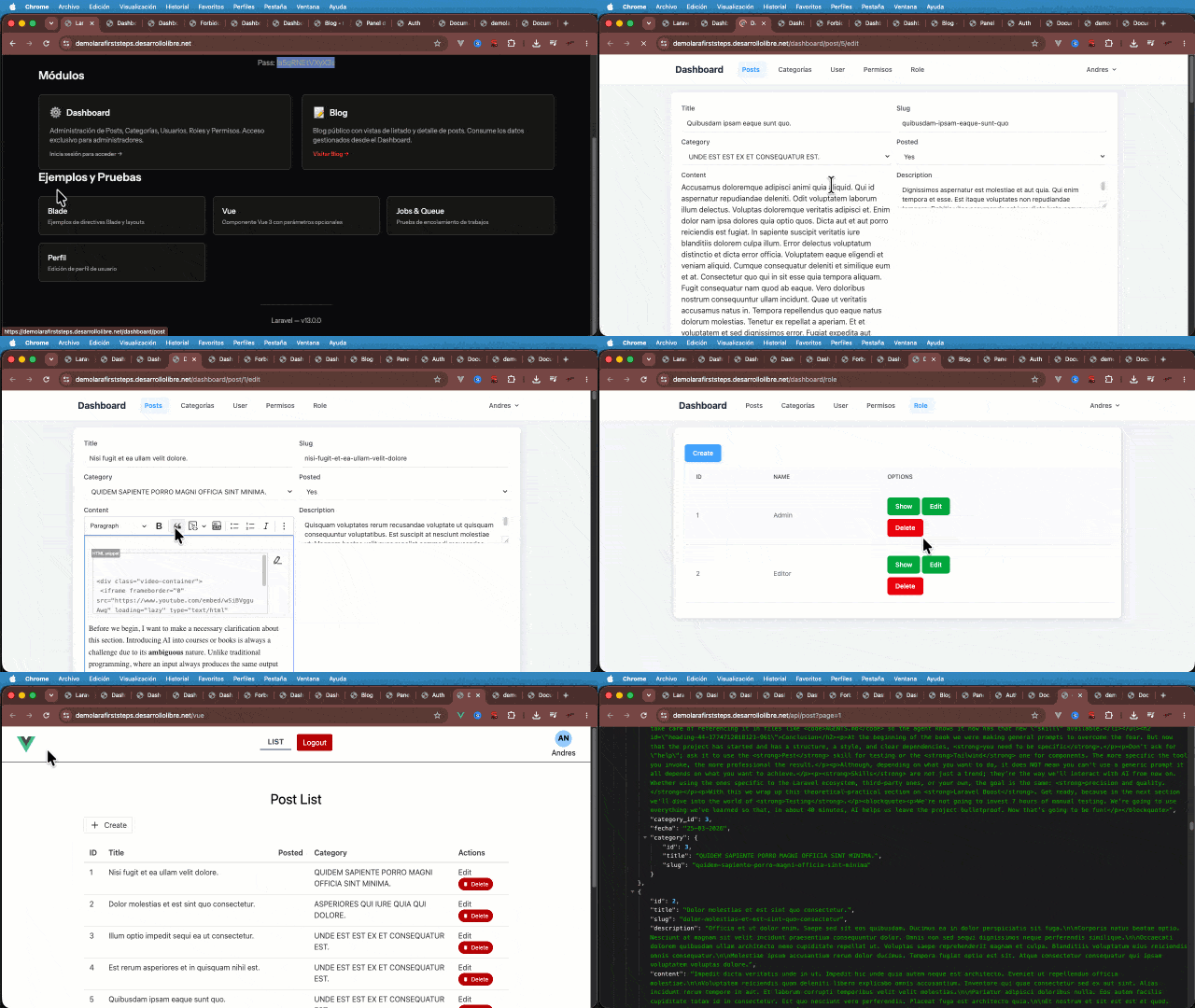
Try the Demo Application
Interact with the final project that you will build in the book.
Why learn Laravel 13 today? (and what makes it so powerful)
Laravel remains the most widely used PHP framework in the world, and not by chance. Each version brings improvements that make development more productive, more elegant, and more scalable. Laravel 13 arrives with important changes in routes, migrations, authentication, and development tools.
Productivity and modern ecosystem
Laravel combines the best of backend development with modern frontend tools like Vite, Tailwind, Vue 3, Node, and of course, an Eloquent ORM that makes working with databases a pleasure.
What changes in Laravel 13 compared to previous versions
Optimizations in authentication, new conventions in migrations, improvements in routing, Artisan commands, and adjustments that facilitate large projects are coming.
I have worked with versions since Laravel 5, so I always dedicate part of the book to showing what is new and what has been left behind.
Laravel 13 to get a job and create real projects
Laravel appears in almost all job offers oriented to backend development with PHP.
Mastering Laravel 13 opens doors for you as a:
- backend web developer,
- full-stack developer with Laravel + Vue,
- API integrator,
- creator of modern scalable applications.
Syllabus of the book
As you well know if you have already taken other of my paid books, I always create a theme throughout the book, and the one for this book is a Blog; so for the creation of a simple Blog we are going to need three modules:
- A module for the dashboard.
- Another for user control.
- And a final one which is a user-facing SPA web that will consume the data through a REST API in Laravel.
In Laravel, you can do many things such as building all kinds of web applications; Laravel is an immense, free framework that allows you to create small projects as well as large-scale projects; among the features we will see in the book are: interacting with databases, using middlewares, setting up servers, communicating with the database, interconnecting systems, and integrating with other technologies like Vue; some of the most important features that can be found in Laravel are:
- A wide set of features for building web applications
- A routing system to handle HTTP requests
- An SQL query builder to interact with databases
- Middleware support to transform and filter HTTP requests
- A large number of standard libraries and additional packages available
- Integration with popular front-end tools and libraries
Content of the Book
In the book we are going to learn about the framework from scratch, down to many specific details of Laravel; it is a basic to intermediate book in which we will see, in short:
- Understanding the basic aspects that drive MVC, such as routes, what each component in Laravel does, and how everything works together.
- Laravel's template engine, Blade.
- Migrations.
- Creating a CRUD module with an authenticated user.
- Installing and configuring Laravel Breeze, Tailwind.css, and Alpine.css
- Creating a module facing the end user.
- Creation and protection of a REST API through Sanctum or Passport.
- Configuring Stripe.
- And universal aspects of Laravel, including helper functions, libraries, best practices, etc.
- We will also learn the basics of Livewire or Inertia.
- We will program in related technologies such as Tailwind, Vue, and Node.
- We will use multiple plugins such as CKEditor for rich content, Vue for SPAs, Tailwind for styling…
- Cache usage.
Summary
- Module 1: Installation, environment, and tools
- Composer, Laravel Installer, server configuration, local environment.
- Module 2: Framework fundamentals
- Routes, Blade, controllers, components, views, helpers.
- Module 3: Professional CRUD with authentication
- Breeze, validations, roles, permissions, form handling.
- Module 4: Secure REST API in Laravel 1
- Tokens, authentication, contracts, pagination, error handling.
- Module 5: Integration with Vue 3 and SPA
- Vite, components, Axios, API consumption, internal routing.
- Module 6: Optimization, security, and best practices
- Cache, storage, Stripe, logs, debugging, clean architecture.
- Module 7: Packages and General Aspects
- Two sections to learn about other aspects of the framework, both native and from third-party packages.
- Module 8: AI in Laravel
- Laravel has a couple of POWERFUL packages to employ AI for developing with Laravel Boost and Laravel AI SDK, to integrate AI into your developments.
We have a chapter on MongoDB that explains in detail how to start using this powerful and famous NoSQL database:
MongoDB
MongoDB is a high-performance, scalable NoSQL database. Unlike relational databases, in MongoDB data is stored in JSON documents, which can be nested. Thanks to JSON, we have a flexible schema to nest and model data.
MongoDB is compatible with many tools, which is ideal since we can use it alongside our developments; for example, we can use it with programming languages like PHP, Python, Java, and Node.js.
Thanks to the integration with PHP, we can use it in a Laravel project.
In summary, MongoDB is a powerful NoSQL database that offers great flexibility in data modeling and features high availability and scalability.
In the book, we have an extensive chapter in which we will cover:
- Learning to connect to MongoDB and perform basic CRUD queries using the terminal client.
- Creating a Laravel project and configuring it with MongoDB; installing EVERYTHING necessary so Laravel can work with MongoDB.
- Making a simple CRUD in Laravel with MongoDB to apply what has been learned.
- Working with one-to-one, one-to-many, and many-to-many relationships in MongoDB.
- Working with one-to-one, one-to-many, and many-to-many relationships in Laravel with MongoDB.
- We are also going to integrate the use of Aggregation functions and Projections in MongoDB and their potential use in Laravel.
All these features and many more will be covered in this guide.
Integrating Laravel 13 with Vue 3
Laravel is a popular PHP framework that simplifies web application development. As we saw earlier, it has enormous potential and general features.
Vue is a JavaScript library for building interactive user interfaces. It can be used alongside Laravel to build more dynamic web applications.
Both technologies can be worked on together, and in this book we walk through the steps to integrate both technologies:
- Install Laravel using Composer.
- Install Vue.js into the Laravel project using NPM.
- Configure Vite with Vue.
- Create Vue.js components and register them in the Laravel application.
- Include the components in Blade templates and use them in the application.
- To handle communication between Laravel and Vue.js, HTTP requests can be made using Axios or the Fetch API.
- It is also possible to use the integration of Inertia.js and Laravel to create dynamic applications without needing to change the template structure; we also cover this introduction basic level in the book (although I have a specific book for Laravel Inertia with Vue).
Unique advantages of this book (that you won't find in others)
Here I am speaking to you from experience:
- Updated to Laravel 13 and maintained for years
- I keep my books UPDATED. If Laravel 14 or 15 comes out tomorrow, this book will receive the corresponding updates.
- Free Community Version included
- If you do not have the money to start, I always provide a 100% free LITE version with essential classes.
- Complete book equivalent to the course
- You also have all the course content in book format, ideal if you like to study offline.
- Support, extra resources, and continuous updates
- On my blog I publish tools, examples, snippets, videos, and best practices that expand upon the book.
Why learn Laravel
There are several reasons why learning Laravel can be beneficial for you:
- Productivity: Laravel is a very powerful tool and the PHP framework par excellence; it allows you to develop web applications quickly and effectively; best of all, it has add-ons and functionalities everywhere, ensuring you will always have a scalable project.
- Documentation: Laravel has excellent official documentation that is easy to follow, filled with examples, and quite extensive; therefore, any questions you have about a library, helper, or general functionality can be looked up in the official documentation.
- Community: Laravel has a large community of developers who use it and contribute to the project; you don't just live off official documentation—on the Internet, you will find an immense amount of information on how to build different developments in Laravel; this book and blog are evidence of that.
- Ecosystem: Laravel has an extremely large ecosystem, which includes everything the framework comes with right out of the box when creating a project, as well as the packages available at our disposal.
- Employability: Laravel is a popular framework in the industry; therefore, if you are a web developer, you will surely have job opportunities since PHP is still the most widely used programming language for developing websites and Laravel is the framework par excellence for PHP.
Author's Real-World Experience
“I have been teaching Laravel and leading production projects for years. In this book I don't just teach abstract theory, but the trenches of real development: how to scale applications, structure clean code for the development team, master Vue SPA, and connect it natively with Laravel. It is the distillation of thousands of hours of deployments and bug fixing. Everything maintained and updated to the latest version of Laravel.”
Frequently Asked Questions
- Who is this book for?
- From people who want to start learning Laravel to intermediate developers who want to master the modern stack (Vue 3, Node, Tailwind 4) professionally.
- Newcomers to the ecosystem: If you want to take your first steps with Laravel guided by experts.
- Developers with a foundation: If you already know Laravel but want to delve deeper into advanced components and best practices.
- Future Professionals: People who want to master the leading tool in PHP to enter the high-level job market.
- From people who want to start learning Laravel to intermediate developers who want to master the modern stack (Vue 3, Node, Tailwind 4) professionally.
- What are the requirements?
- To make the most of this book, you only need:
- Essential knowledge: Having had a first contact with HTML, CSS, JavaScript, and PHP (even if it's just a simple application).
- Basic tools: A PC running Linux, Windows, or MacOS.
- Winning Mindset: A desire to learn and the ambition to get ahead in the tech world!
- To make the most of this book, you only need:
- Is the book kept updated?
- Yes. I keep my books updated. If Laravel 14 or 15 comes out, this book will receive the corresponding updates for enrolled students for FREE; for Laravel, I try to keep it updated for at least 3 years (the books are for life).
- Why choose Laravel as your main tool?
- An ecosystem designed for efficiency: Laravel is not just a framework, it is a working philosophy that allows you to be incredibly productive. In this book you will learn to orchestrate cutting-edge technologies:
- Tailwind 4 & Dynamic UI: Learn to create modern, responsive, and visually striking layouts without leaving your HTML.
- Vue.js & SPAs: Transform your applications into high-performance Single Page Applications using our Rest API in Laravel.
- Power with Node & NPM: Optimize the client experience by managing dependencies and packages professionally.
- Mastery of Artisan & PHP: Automate tedious tasks and write clean, maintainable code.
- Is the book equivalent to the Course?
- You also have all the course content in book format, ideal if you like to study offline.
- “Fast updates for a market that never stops.”
- While major version updates may require a total renewal of video courses, the book format is my most agile resource. This allows me to deliver improvements, corrections, and adaptations to the latest tools on the market in record time, guaranteeing that your reference guide never becomes obsolete.
- Support, extra resources, and continuous updates.
- On my blog I publish tools, examples, snippets, videos, and best practices that expand upon the course and are drawn from the book and course.
- You also have all the course content in book format, ideal if you like to study offline.
- I don't have money
- If you do not have money to start, I always provide a 100% FREE LITE version with essential classes and the community book.
- An ecosystem designed for efficiency: Laravel is not just a framework, it is a working philosophy that allows you to be incredibly productive. In this book you will learn to orchestrate cutting-edge technologies: