Content Index
- What is FastAPI? and its Essential Components
- Core Architecture: Starlette and Pydantic
- Importance of Pydantic in Artificial Intelligence Integrations
- Main Features of FastAPI
- When and Why Choose FastAPI, When is the Right Time?
- Prerequisites
- The Project Factor: Ideal Use Cases
- Artificial Intelligence Integration and Asynchronous Processing
- Automatic Documentation and Modular Ecosystem
- Main Features of FastAPI: Why Choose It?
- 1. High Performance and Asynchronous Concurrency
- 2. Strict Validations and Data Conversion with Pydantic
- 3. Automatic Interactive Documentation
- 4. Dependency Injection System
- 5. Native LLM Integration and Streaming
- 6. Modular Architecture and Freedom of Choice
- Key Advantages Summary
What is FastAPI? and its Essential Components
Similar to the Q&A series dedicated to Laravel and Django, this section covers the fundamental features of FastAPI, a modern framework designed specifically for building high-performance web APIs with Python, featuring automatic data validation and interactive documentation generation.
Core Architecture: Starlette and Pydantic
FastAPI's architecture relies primarily on two indispensable tools within the Python ecosystem:
- Starlette: An ASGI (Asynchronous Server Gateway Interface) web toolkit and server focused on high performance and asynchronous processing. It allows handling a high volume of requests per second with lower resource consumption compared to traditional synchronous frameworks.
- Pydantic: A library responsible for data validation and schema management using Python data types. It allows defining models where constraints such as required fields, minimum or maximum lengths, and custom validations are specified.
Importance of Pydantic in Artificial Intelligence Integrations
Pydantic has become an essential standard in AI development. Since AI models generate probabilistic and variable outputs, Pydantic ensures that the output produced by the model strictly complies with the data structure required by the application.
Main Features of FastAPI
- High Asynchronous Performance: Natively designed to support asynchronous concurrency via
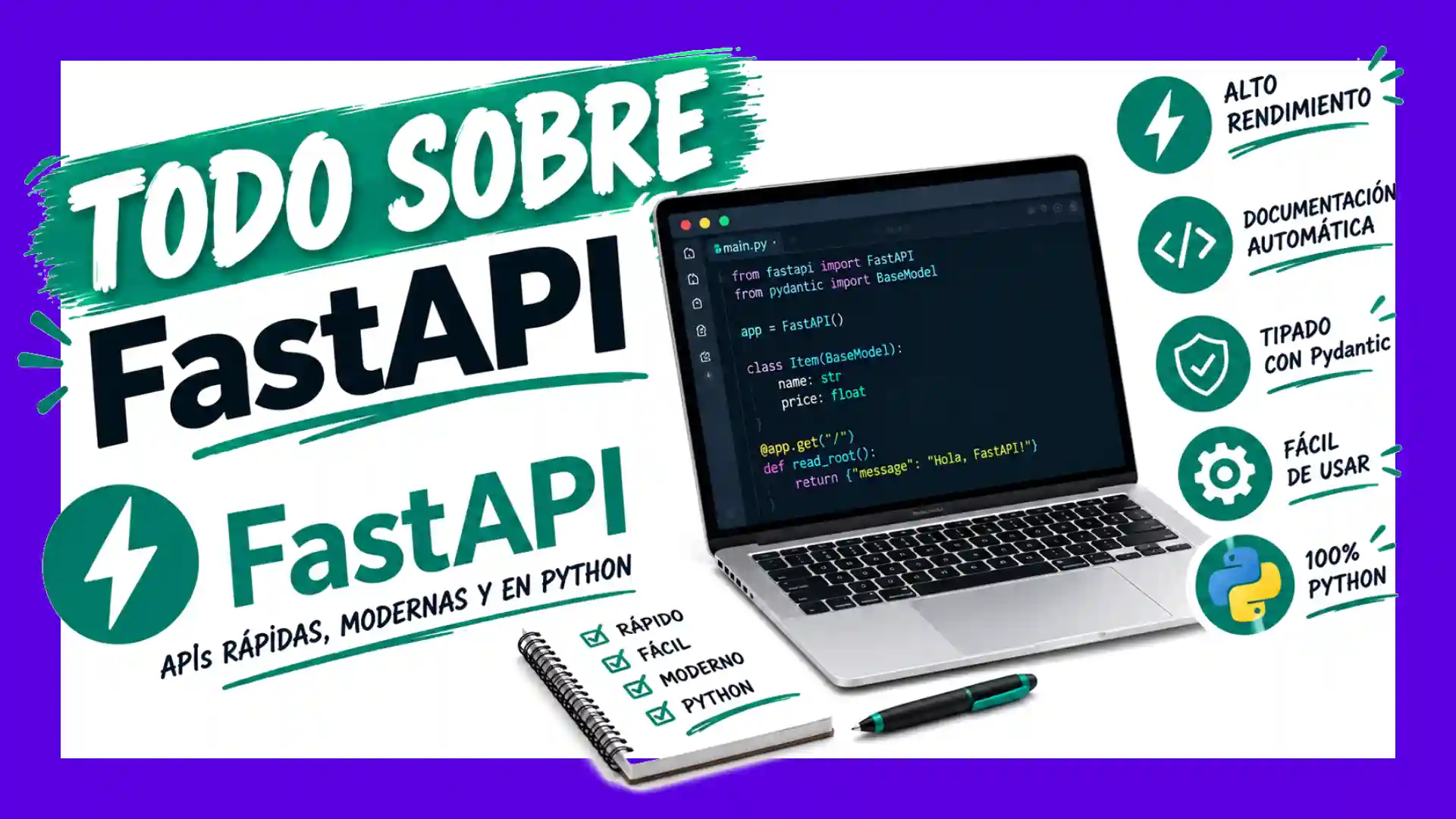
async/await, offering response metrics comparable to environments like Node.js or Go. - Automatic and Interactive Documentation: Automatically generates endpoint documentation (Swagger UI / ReDoc), making it easy to test routes directly from the browser without relying on external tools like Postman.
- Automatic Validation via Typing: Type checking for incoming HTTP request data based on Pydantic schema definitions.
- Dependency Injection System: Allows injecting reusable logic (such as user authentication, database session management, or parameter resolution) directly into the route handler functions.
When and Why Choose FastAPI, When is the Right Time?
Determining the right time to learn or implement FastAPI mainly depends on two factors: your level of prior technical knowledge and the specific requirements of the project to be developed.
Prerequisites
To approach FastAPI effectively, it is necessary to master certain fundamental concepts of the language and web architecture:
- Python primitives and typing: Fluent handling of data structures (lists, dictionaries) and type annotations (type hints, such as
Optional), which are essential for defining schemas and validating data. - Asynchronous programming: Understanding the
async/awaitmodel. Unlike Django or Flask, which originated as synchronous frameworks, FastAPI's core is natively asynchronous. - REST Architecture Fundamentals: Knowledge of HTTP status codes, request methods (GET, POST, PUT, DELETE), and endpoint design.
- Data validation with Pydantic: Mastery of the core library used by FastAPI for defining data models.
Due to its level of abstraction, FastAPI's learning curve can be steeper than that of traditional options. Therefore, in a learning roadmap, it is advisable to first understand the basics of a synchronous microframework like Flask before moving on to FastAPI.
The Project Factor: Ideal Use Cases
FastAPI particularly excels when the goal of the project is not to build a traditional website based on template rendering or monolithic admin panels, but rather to develop services with specific requirements:
- REST APIs for modern clients: Backend interfaces designed to be consumed by mobile applications (Flutter, React Native) or built with frontend frameworks (Vue, React).
- Rapid development and high performance: Fast implementation of components with reduced response times and lower resource consumption per request.
- Microservices Architectures: Building independent, modular, and decoupled services from the main system.
Artificial Intelligence Integration and Asynchronous Processing
In projects integrating artificial intelligence models (whether local or via external APIs such as OpenAI, Ollama, or agent frameworks like CrewAI), FastAPI becomes an ideal tool for the following reasons:
- Strict structuring with Pydantic: Guarantees that the probabilistic responses generated by AI models strictly match the expected JSON schema of the application.
- Real-time responses (Streaming): Facilitates sending data token by token using classes like
StreamingResponse, allowing progressive transmission of the AI response without blocking the server. - Handling high-latency requests: Since queries to language models are naturally slow, the asynchronous server (Starlette) processes multiple concurrent requests without overwhelming execution threads.
Automatic Documentation and Modular Ecosystem
Since it is not a monolithic ("batteries-included") framework, FastAPI provides total flexibility to select tools within the ecosystem: you can freely choose the ORM (SQLAlchemy, Tortoise), database engine (PostgreSQL, MongoDB), or migration tools (Alembic).
Additionally, it natively generates interactive system documentation (Swagger UI and ReDoc), allowing you to test API endpoints directly from the browser during development.
Main Features of FastAPI: Why Choose It?
FastAPI has positioned itself as one of the preferred frameworks in the Python ecosystem for building REST APIs and microservices. Its modern design, execution speed, and excellent support for consuming Large Language Models (LLMs) and Artificial Intelligence make it an outstanding choice in modern backend development.
1. High Performance and Asynchronous Concurrency
FastAPI is designed to offer maximum efficiency and speed. This is due to its architecture based on Starlette (for the web layer) and Uvicorn (as the ASGI server), enabling it to process thousands of requests concurrently with superior performance compared to traditional frameworks like Django or Flask.
2. Strict Validations and Data Conversion with Pydantic
The framework integrates Pydantic for data validation and serialization. This feature facilitates working with forms and HTTP requests as well as structuring outputs generated by AI models (LLMs), ensuring the returned format strictly complies with the expected schema.
Furthermore, Pydantic performs automatic data type casting (for example, string to URL, integer, or date) and generates corresponding HTTP error responses in case of validation or typecasting failures.
3. Automatic Interactive Documentation
Every time an endpoint is defined, FastAPI automatically generates interactive documentation accessible at /docs (Swagger UI) or /redoc (ReDoc), with no additional configuration required.
From this interface, you can group routes, add descriptions, test requests with specific headers or parameters, and validate authentication mechanisms directly in the browser.
4. Dependency Injection System
Dependency injection in FastAPI allows you to reuse business logic throughout the application without duplicating code, keeping the architecture clean, modular, and easy to test.
Below is the basic structure of an endpoint with data validation and dependency injection:
from fastapi import FastAPI, Depends, HTTPException, status
from pydantic import BaseModel

app = FastAPI()

# Pydantic validation model
class AuditLog(BaseModel):
    action: str
    user_id: int

# Dependency function for authentication
def get_current_user(token: str):
    if token != "secret-token":
        raise HTTPException(
            status_code=status.HTTP_401_UNAUTHORIZED,
            detail="Invalid token"
        )
    return {"user_id": 1, "username": "admin"}

# POST endpoint with validation and dependency injection
@app.post("/audit", response_model=AuditLog)
def create_audit_log(
    log: AuditLog,
    current_user: dict = Depends(get_current_user)
):
    return log
5. Native LLM Integration and Streaming
FastAPI's asynchronous architecture provides native support for streaming responses (such as StreamingResponse). This is essential for integrating with language models and Artificial Intelligence, where responses are sent progressively token by token in real time as they are generated.
6. Modular Architecture and Freedom of Choice
Unlike "batteries-included" frameworks like Django or Laravel, FastAPI does not enforce a specific ORM or database structure. This flexibility allows you to freely integrate tools like SQLAlchemy, SQLModel, Tortoise ORM, or NoSQL databases like MongoDB according to your project requirements.
Key Advantages Summary
- High performance: Powered by ASGI, Starlette, and Uvicorn.
- Automatic validation: Deep integration with Pydantic.
- Built-in documentation: Automatic generation with Swagger UI and ReDoc.
- Dependency injection: Decoupled, modular, and testable code.
- AI Support: Native asynchronous responses and real-time streaming transmission.
- Total flexibility: Free choice of components and database engine.