Content Index
- Why choose the Book format for your training?
- From Beginner to Senior: The Truth About Creating an E-commerce
- Why Django is the Ideal Engine for Your Store?
- Scalable E-commerce: The why behind things
- Decision Table: Product Modeling
- The "Pro Approach": Centralized Payment Management
- Your Learning Path: Mastery in Reactive E-commerce
- Guaranteed Book Phases:
- Free Resources to Start NOW
- Sample Book and Concepts
- Live Demo
- Why choose Django for your store?
- Productivity and Organization
- What will you learn and who is this book for?
- Detailed Syllabus Book
- Unique Benefits of this Training
- Scalable architecture based on a global payment entity
- Stripe, PayPal and more: gateways ready to grow
- Real-world logic to customize products and catalogs
- Optimized client-server interaction with Django
- Author's Experience in the Real World
- Frequently Asked Questions
- Algunas recomendaciones
Creating an online store can be as simple or as complex as the architecture behind it. And if there is one thing I have learned from developing real applications, it is that an e-commerce should not be an improvised puzzle. That is why I designed this training, tailored for those looking to build a professional, scalable, and maintainable platform.
"If you have ever felt like managing shopping carts and payment gateways is a maze, let me tell you something: Django is the superpower your online store needs to be reactive and robust."
You can see the details of the book at the bottom of this publication. This is a strategic investment: we combine book and book so that you understand not only the "how", but also the technical "why" behind each module, guaranteeing that you can adapt the solution to any real business.
Many believe that Django is only for CMS or APIs. In this book, I show you that, with a good model architecture and the correct use of Class-Based Views, you can build a more solid and secure store than any PHP solution in half the time.
What you will learn in this Master book
- Payment Architecture: How to centralize logic using a scalable global Payment entity.
- Pro Gateways: Layered integration of Stripe and PayPal for pain-free maintenance.
- Reactive Interaction: Instant synchronization of carts, stock, and filters using Django.
- Business Modeling: Deciding between generic or specific entities depending on the type of product.
- Full-Stack e-Commerce: From the administrative CRUD to the final user checkout experience.
Why choose the Book format for your training?
While our video books are ideal for following step-by-step, the book version of [Technology - e.g. Laravel 13] is designed for those developers looking for a quick technical reference resource and a more reflective learning experience.
- Ideal for instant queries: Thanks to its structured index and internal search engine, you can locate that design pattern or code configuration in seconds, without having to navigate through minutes of video.
- Deep reading without distractions: Perfect for studying at your own pace, underlining key concepts, and diving deep into software architecture during those moments of disconnection.
- Total portability (PDF, ePub, and Kindle): Take your training with you. Whether on your tablet, e-reader, or smartphone, you will have access to the entire DesarrolloLibre ecosystem without needing an internet connection.
- The perfect complement to code: While the book teaches you the implementation, the book goes deeper into the "why" of each technical decision, becoming your reference manual for daily professional life.
From Beginner to Senior: The Truth About Creating an E-commerce
Learning to create an online store today can be a chaos of tutorials that only teach you how to build basic CRUDs. The big question is always: "How do I handle payments securely and scalably?". In this training, we skip the basics to focus on real architecture.
If you already work with Django and want to take the leap to high-level projects without getting lost in repetitive configurations, you are in the right place. Here we do not waste time installing the framework; we go straight to the engineering decisions that separate a programmer from a software architect.
Why Django is the Ideal Engine for Your Store?
Django allows you to keep server logic seamlessly synchronized with the client interface. In an e-commerce, where prices, stock, and the cart constantly change, this efficiency is pure gold to offer a premium user experience without the complexity of a heavy SPA.
Scalable E-commerce: The why behind things
“It is not enough for it to work; it must be maintainable. Creating a layered system for payment gateways is not an option, it is a necessity to prevent your code from becoming a maze when you decide to add a new payment method.”
Decision Table: Product Modeling
| Approach | Key Concept | What is it for? | Priority |
|---|---|---|---|
| Generic Entity | Global Product Entity | Multi-purpose stores with similar attributes (clothing, accessories). | High (Standard) |
| Specific Entity | Domain Specific | Businesses with unique logic (digital books, subscriptions, courses). | Medium-High |
The "Pro Approach": Centralized Payment Management
See how we move from a coupled and hard-to-maintain payment logic to an elegant system based on a global entity:
// In the Controller
if ($gateway == 'stripe') {
    $stripe->charge($amount);
} elseif ($gateway == 'paypal') {
    $paypal->pay($amount);
}
// Hard to scaleclass BasePayment(PaymentPaypalClient, PaymentStripeClient):
def __init__(self):
super().__init__()
def process_order(self, order_id:str, type:str) -> bool:
if Payment.objects.filter(orderId=order_id).exists():
self.message_error = _("Order Already Paid")
return False
if type == 'paypal':
# Paypal
return self.process_order_paypal(order_id)
elif type == 'stripe':
# Stripe
return self.check_order_stripe(order_id)In the book, I will teach you how to centralize your transactions so that adding new gateways becomes a matter of minutes, not days.
Your Learning Path: Mastery in Reactive E-commerce
I have designed this methodology so you can go from defining your models to achieving a complete sales system with support for multiple products and gateways.
Guaranteed Book Phases:
- Phase 1: Structure and Blog. Migrations, core models, and creation of a content system to attract traffic.
- Phase 2: Reactive Catalog. Paginated listings, dynamic filters, and product details optimized with Django.
- Phase 3: Payment Gateways. Layered implementation for Stripe and PayPal through the global payment entity.
- Phase 4: UX and Polish. Language localization, dark mode, advanced design, and payment tracking module.
Free Resources to Start NOW
Access high-quality material at no cost and check the technical level we will reach:
Sample Book and Concepts
Explore the first chapters where we define the structural basis of what will be your next great online store.
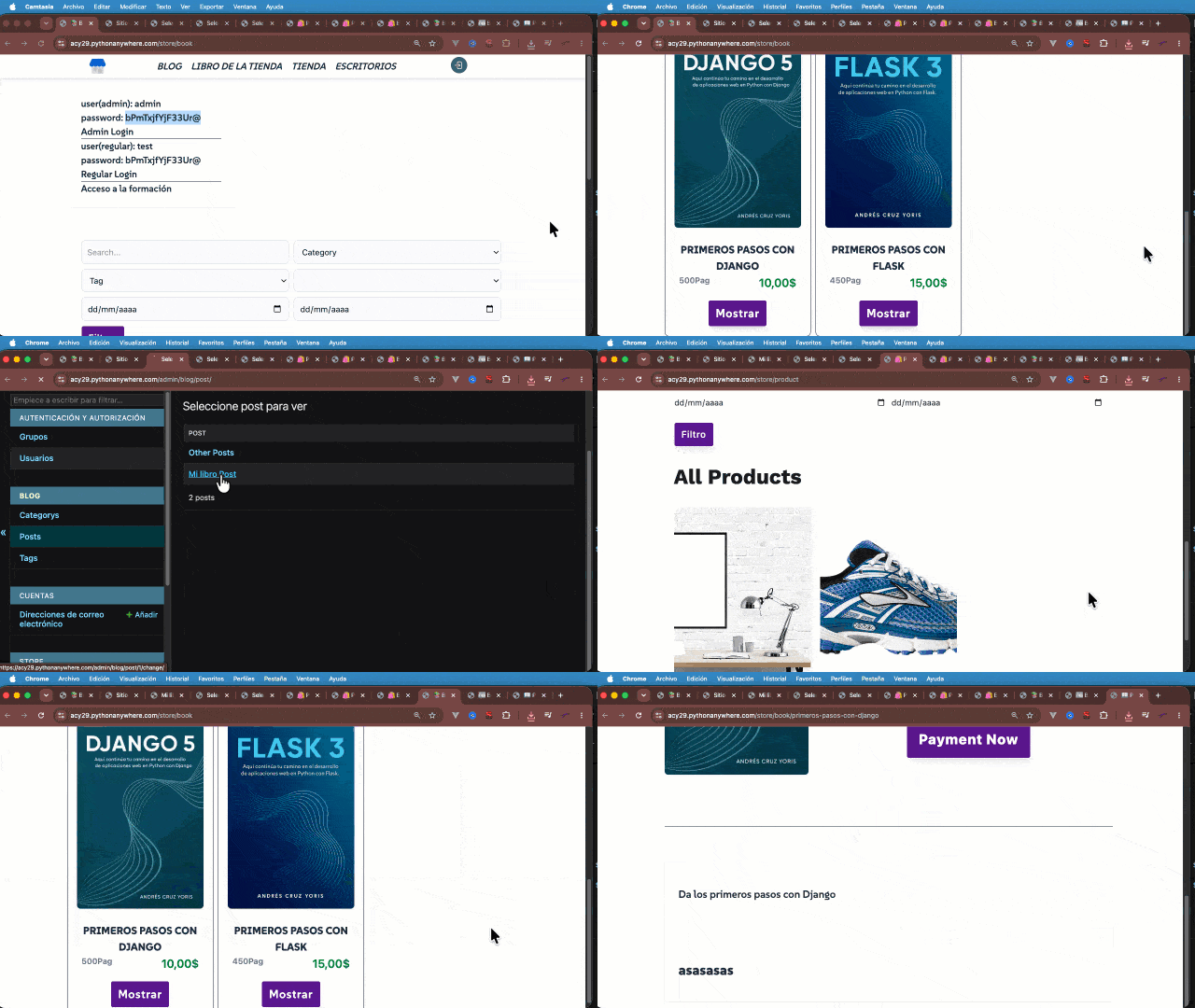
Live Demo
Interact with the final application. Check Django's fluidity and the robustness of the payment system:
Why choose Django for your store?
Django is ideal when you need to frequently communicate between client and server in a reactive way. In an e-commerce, this means dynamic carts, real-time stock validation, and payment flows without abrupt reloads.
Productivity and Organization
Thanks to Django, you get an impeccable organization. It is a fast, powerful, and extensible framework that allows you to create maintainable and scalable real applications without the headaches of traditional decoupled developments.
What will you learn and who is this book for?
Learning to create a professional store does not have to be a constant process of trial and error. Here I take you from data modeling to the deployment of international gateways.
If you already master the basics of Django, this book is your next logical step to build professional-level projects.
Centralized payment logic for Stripe and PayPal.
Generic vs specific product modeling.
Modern reactive interfaces with Tailwind CSS and Django.
Detailed Syllabus Book
This training is divided into 7 strategic blocks to guarantee your learning:
- Module 1: Foundations and Database
- Professional project initialization.
- Advanced relational models and migrations.
- Module 2: Content and Blog
- Administrative CRUD for posts, categories, and tags.
- User interface with filters and reactive pagination.
- Module 3: The E-commerce Engine
- Layered integration of PayPal and Stripe.
- Creation of a generic product store.
- Customization: Languages, dark mode, and payment visualization.
Unique Benefits of this Training
- Django 7 Update: The book will keep up to date with new versions of the framework at no additional cost.
- Course + Book Duo: Detailed video explanations and impeccable technical structure in written format.
- Architectural Approach: We don't just make it work, we teach you why we make every decision.
- The Admin "Superpower": Django Admin so that the client can manage orders, stock, and customers without you having to program a dashboard from scratch.
Security by Default: Django protects against SQL Injection, XSS, and CSRF natively, which is vital for a store that handles money.
Powerful ORM: Explains how the Django ORM facilitates complex queries for sales reports that would be an SQL nightmare in other frameworks.
Scalable architecture based on a global payment entity
When working with different gateways, I realized that creating isolated logic for each one was a bad idea. That is why I implemented a global entity called Payment, and in the book, I show you exactly how to integrate it so you can connect Stripe, PayPal, or other gateways without rewriting your code.
Stripe, PayPal and more: gateways ready to grow
I clearly remember that when I integrated both systems, I thought: “this needs to be scalable from the very start.” That is why I programmed a layered system that I teach you step-by-step. You will end up with a solid, organized gateway that is ready for other methods.
Real-world logic to customize products and catalogs
Not all stores work the same way, which is why in the book I show you two different approaches:
- Generic product-type entity,
- Specific entity according to the business type.
This allows you to adapt the store to your needs without breaking the architecture.
Optimized client-server interaction with Django
When I first tried Django on this project, I was surprised by how easy it was to keep logic synchronized with the backend. In an online store, where there are shopping carts, stock, filters, and constant updates, that efficiency is pure gold.
Author's Experience in the Real World
“I have been building real e-commerce platforms for years and have seen how improvised stores fail when trying to scale. In this training, I have documented every architectural decision so that you don't make the common mistakes. I teach you how to create a centralized and scalable payment system, just like the one I implement in my own professional developments.”
Frequently Asked Questions
- Who is this book for?
- Developers who already know Django and want to master the creation of online stores.
- Programmers looking to learn modular architecture and payment gateways.
- What prerequisites do I need?
- Intermediate knowledge of Django (Routes, Models, Ecosystem).
- A desire to learn how to model a real digital business!
- “Quick updates for a market that never stops.”
- While major version updates may require a complete overhaul of video courses, the book format is my most agile resource. This allows me to deliver enhancements, fixes, and adaptations to the latest tools in the market in record time, ensuring that your reference guide never becomes obsolete.