Content Index
- Catalog Status and Update Philosophy
- Advantages of the Proprietary Book Format
- Virtual Stores with Livewire, Laravel Base, and Django
- Double Updates in Laravel Books
- Native Android and Django 6
- Flask, MongoDB, and Dashboard Empowerment
- CodeIgniter 4: Learning Path and Inventory
- Components and Animations in Flutter
- Writing Improvements in FastAPI, Forge2D, and Vue 3
- Complete Restructuring of the Flutter Book
- Practical Projects in Alpine.js 3
- Bootstrap 5 and CSS Transition Optimization
- Flame, Electron, Docker, and FastAPI AI
- Web Fundamentals, Three.js, and Server-Driven UI
- Conclusion
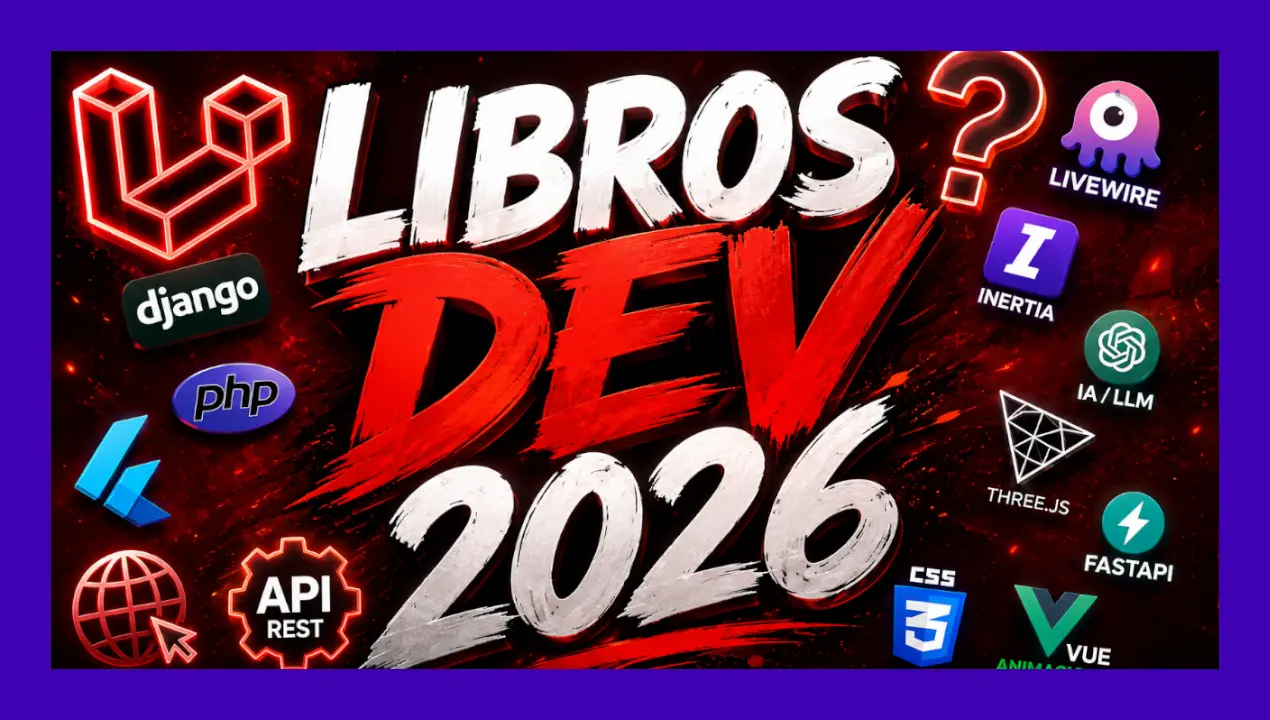
I have completed a thorough review and update of my entire software development book catalog. Below, I present the current status of the publications, the structural changes implemented, and the update roadmap for each technology.
Catalog Status and Update Philosophy
Keeping a technical book alive is a fundamental commitment. There is no worse experience for a developer than following a text or a tutorial with outdated code. Books represent my favorite educational format due to their flexibility: they allow for the incorporation of technological changes, error corrections, and expanded explanations much more agilely than a video course, which requires complete re-recordings from scratch with every version change (as usually happens with Laravel).
In this major review, the following global measures have been taken:
- Writing and formatting improvements: Explanations were restructured so that the books do not depend on video courses. They now function 100% autonomously as self-contained manuals.
- Environment updates: Recommendations for old local environments (such as XAMPP or Laragon) were migrated toward modern architectures based on containers with Dev Containers (in Linux, macOS, or Windows environments).
- Repository synchronization: All associated projects have been cloned, tested from scratch in clean projects, and updated on GitHub to ensure there are no broken dependencies with the latest versions of the technologies.
Advantages of the Proprietary Book Format
Compared to the traditional model of video courses hosted on third-party platforms (such as Udemy or external academies), the digital book offers an advantage of absolute ownership:
- Real ownership: The content is permanently yours. You do not depend on the existence or policies of a third-party platform that could take down the material or close its services.
- Portability and space: A 40 or 50-hour video course can take up between 30 and 40 GB of hard drive space if downloaded, becoming obsolete quickly. In contrast, a complete technical book (like the CodeIgniter 4 one) concentrates all the knowledge into a compact PDF or EPUB file of approximately 10 MB, easy to store and consult on any device.
Virtual Stores with Livewire, Laravel Base, and Django
The books dedicated to building online stores have been updated. The main objective of this review was to unify the cover designs to maintain a homogeneous editorial line throughout the academy (with the exception of the Vue Native text, a technology that has been discontinued by the market).
- Laravel + Livewire: The base structures of the e-commerce project were unified to guarantee direct compatibility with the current guidelines of the framework.
- Django 6: The formal migration of the virtual store project from Django 5 to Django 6 was carried out. Since these are very specific changes in the core of the framework, the code remains stable, but the review was used to expand and detail the theoretical chapters.
Double Updates in Laravel Books
The suite of books focused on the Laravel ecosystem (consisting of the base Laravel book, the Livewire book, and the Inertia.js book) received a double update cycle. Following the initial release of Laravel 13, continuous reviews were processed to incorporate the framework's most recent directives and components.
Chapters and examples dedicated to advanced interface features were added, such as:
- Loading structures and waiting states (wire:loading).
- Synchronization of active routes (wire:current).
- Native transitions and animations combined with CSS.
- State control for clean or modified forms (wire:dirty).
Explicitly informative sections were included in these books. Through architecture notes, it is clarified to the reader which tools are demonstrative to expand their technical judgment in real environments, without the need to mandatory implement them in the book's base projects.
Native Android and Django 6
- Android: The compendium of technical guides and public articles was integrated and modernized, structuring the content under a formal and accessible book format.
- Django 6: The major update released at the end of the year was consolidated, ensuring that all routing and ORM components are aligned with version 6 of the framework.
Flask, MongoDB, and Dashboard Empowerment
The Flask book received a considerable expansion of practical content through the rescue and modernization of classic projects from my catalog:
- Advanced Administration Module: The interfaces and logic of the control panel originally developed in the early editions were updated.
- Billing System: A practical project for inventory management and invoice issuance was reincorporated under the current Python syntax.
- MongoDB Integration: Non-relational persistence content in Python (previously distributed as a modular Django and Flask course) was formally integrated, unifying the project under a complete demonstrative workflow using Flask and MongoDB.
CodeIgniter 4: Learning Path and Inventory
CodeIgniter 4 remains an excellent choice for developers starting out with the MVC pattern or looking for a lightweight framework with a clean syntax, free from the massive volume of weekly updates that characterize tools like Laravel.
- Learning Path: A paths section has been added to the platform where CodeIgniter 4 is positioned as the ideal intermediate step in Full-Stack development, situated just before making the leap to denser frameworks.
- AutoCRUD and Inventory Projects: The code for the practical inventory and automatic CRUD generation projects was completely migrated and rebuilt. Compatibility with current versions of PHP was verified line by line to ensure that the educational exercises continue to function predictably.
Components and Animations in Flutter
The book focused on creating user interfaces and advanced components in Flutter received a profound renovation, leaving behind dependency on external releases:
- Repository Update: All projects were migrated to the latest stable versions of the SDK, replacing obsolete elements of the design API (such as the old button nomenclature).
- New Advanced Interface Chapters: Practical sections were added on the use of Sliver components to create scrolling effects and collapsible toolbars.
- Animations and Transitions: Chapters dedicated to drag-and-drop element control, dark mode management, and the integration of rich third-party animations using professional tools like Lottie and Rive were incorporated.
Writing Improvements in FastAPI, Forge2D, and Vue 3
- FastAPI: Complete style review, cleanup of filler words, and optimization of explanations regarding the construction of asynchronous APIs.
- Flutter Flame + Forge2D: Update of the internal documentation for physics and two-dimensional video game logic to guarantee the code remains current.
- Vue 3: Writing adjustments focused on the composition architecture (Composition API) and global state management using Pinia.
Complete Restructuring of the Flutter Book
The core Flutter text was almost entirely rebuilt. During the migration process from old documentation platforms (such as Google Docs) to the academy's native editing system, the ten practical projects that structure the book were reviewed, completed, and expanded. This edition represents an extensive practical development manual, fully adapted to current development standards.
Practical Projects in Alpine.js 3
The content of the Alpine.js book was expanded with the addition of new practical projects based on interactive card components. The text delves into combining Alpine.js with Tailwind CSS, demonstrating how to solve client-side interactivity in a lightweight manner (such as modals, dropdown menus, and theme selectors) without resorting to massive frontend frameworks.
Bootstrap 5 and CSS Transition Optimization
The Bootstrap 5 book received an update focused on web performance efficiency. In addition to reviewing classic components, an optimizations chapter was added that teaches how to replace transitions based on heavy sizing properties (width and height) with hardware-accelerated properties like transform and opacity, guaranteeing smooth animations at 60 frames per second.
Flame, Electron, Docker, and FastAPI AI
Software architecture sections were structured for advanced projects:
- Electron: Maintenance of hybrid desktop projects.
- Docker: Project-style book format, sharing the foundations of web service containerization in a structured way.
- Flask/FastAPI + AI: Introduction to integrating language models and intelligent services within asynchronous microservices.
Web Fundamentals, Three.js, and Server-Driven UI
Fundamental manuals from the historical catalog were rescued and integrated:
- Server-Driven UI Widgets: Project focused on building interfaces in Flutter dynamically dictated from a backend in Laravel or Node.js via REST APIs.
- Three.js (3D Development): Update of interactive content for creating three-dimensional scenes on the web. Local chapters were added to the platform dedicated to lighting management, particle rendering, and initial setups for virtual reality (VR) environments, allowing web developers to take their first steps in computer graphics.
Conclusion
All mentioned updates are available for immediate download in standard formats (PDF and EPUB) through the usual distribution channels. The academy's management panel has been optimized to accurately reflect the latest review dates, ensuring total transparency regarding the currency of the material.